I have reflected before on the why of my scope and sequence. But very basically the children in my class were the why, they showed me that before anything else, they needed a deep sense of pattern and number. Just as my journey through structured literacy showed me that children needed that deep phonological and phonemic awareness.
It has also been so lovely to hear from our new entrant class of 2022 that the scope and sequence is proving just as beneficial for them as it was for me last year.
If you want to know more, there is an old blog post from last April that describes this in more detail.
I started this process out of a want and real need to understand why children might struggle with maths and an interest in learning more about dyscalculia. I avidly read everything I could and listened to podcasts whenever I went walking. The work of Christopher Woodin really spoke to me and his patterns have since been a real game changer.
When I wrote this scope and sequence (as I was teaching it) I also wrote the next sessions..after I saw how well it it was working for me and really wanted others to be able to teach in this way.
At the time I thought it might last for 6 months if that. But I started last year in March and am still working my way through it with my class that started with me. It has had a huge impact, but we are only up to session 52 (of 60). Granted we only work in this way two - three times a week, but I think the scope and sequence is more like 1 year - 18 months worth of learning. Once I am completed session 60 I intend to go back through all the sessions and add to them or change them according to what I learned.
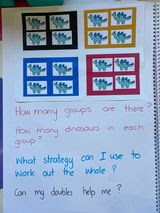
We are currently on session 52 (grouping) we are likely to stay on this session for at least the next two weeks...repetition is key, children need to explore the same concept in a range of different ways many many times. This is true for any learning.
As I sit and watch them working with visual images, I can't help but be blown away by the strategies they are employing independently. This is even more impressive when I remember that many of these children didn't have a sense of number when they started, couldn't look at a group and make a good guess at how many there could be, and would often grab a handful when they only needed a couple more.
This term we have opened a modified agency, based on a portal that connects us to many different worlds. It fits well time wise and means we can do this and continue to work on our scope and sequence...all within the world of our play-based class.
This scope and sequence has really gifted children a sense of a whole and its parts...friends to ten, doubles, using five, they all make sense. Number bonds are really deeply understood as is the concept that problems like 3 + 5 and 5 + 3 is the same and that if I know these, then I know the reverse, 8-3 is 5 etc. Now we are also developing the understanding that 5 x 3 and 3 x 5 gives us the same whole. Flexibility with number is coming through loud and strong.
I have spent longer on grouping than intended and so have made up more visual images to go along with this, I will add the pack to the scope and sequence at some stage.
The key is the patterns and spending a lot of time consolidating these...the woodin patterns seem so simple, but for many these patterns have given them something to really establish their understanding of a whole and its parts. Now we are further into the scope and sequence, some children are beginning to express groups in different ways, while those that need to will still defer to the patterns.
If you are picking up the scope and sequence for the first time, follow the sequence, combine sessions if it makes sense for your class, but don't skip, don't pick and mix...it is intended to be cumulative, so trust in the process.
I don't advocate worksheets and we don't work in math books. We use whiteboards, markers and materials...along with this talk is key, lots of sharing and lots of reflecting.
To say I am happy with where we are at is an absolute understatement...this has to be one of the best things I have done in my career and I am very happy with how everything is going.
The reflections below are just some of the understandings we have been developing.




Comments
Post a Comment