So, I have done a few posts in my facebook math group alluding to the fact that for a range of reasons I have had to alter the way I teach maths this year.
In the past I would have launched quickly into agency and Professor would have managed the knowledge and strategy development. Unfortunately (or fortunately for my learning purposes) my class this year are on the whole developmentally lower than usual and their number sense is not what we would normally call a starting point.
Let me explain firstly that this isn't deficit thinking, it is me acknowledging that the best approach for the class currently in front of me isn't the dramatic/imagined world I usually present. It wouldn't be the best use of my teaching time and developmentally they need maximum playing time...social and emotional needs must come first.
Running parallel to this discovery has been my learning in structured literacy, which led to me thinking more about how we can have a more structured approach to maths. The narrow system we currently have has always bothered me...we just don't dig deep enough to truly understand why a child may be having difficulty.
Structured literacy has shown me how much I could be missing or taking for granted...it is the same for mathematics, there is a lot we take for granted.
Therefore rather than ploughing on doing what I have always done, I decided to do some more research into the big ideas of mathematics, the building blocks and how these all slot together to ensure children make progress.
My starting point was to find out my about dyscalculia ...my journey with structured literacy showed me that an understanding how children that struggle with literacy need to learn to read and write, so my thinking here was I needed to do the same with maths. This led me to Chris Woodin from Woodin maths. https://www.woodinmath.com/free-materials/curriculum-bank his vertical pathway is full of useful stepping stones.


I also love Number blocks! They are sequenced so incredibly well and if you have not used them with your class, you really should, but do it in order as they follow their own scope and sequence.
In conjunction with this has been the work of Jo Boaler (who is an absolute legend!) Her mathematical mindsets in K curriculum have a huge amount to offer.
I now have a set of indicators within the big ideas that break down the key skills and assists me with planning and assessing. I am already loving it, but it has a long way to go.
What I have discovered is that it is possible to take a more structured approach to maths. Just like literacy it needs to be explicit and follow a scope and sequence that allows us to identify clearly any specific strengths and needs. When followed in a structured way, we also get a great insight to a child that may be having difficulty, earlier, rather than later.
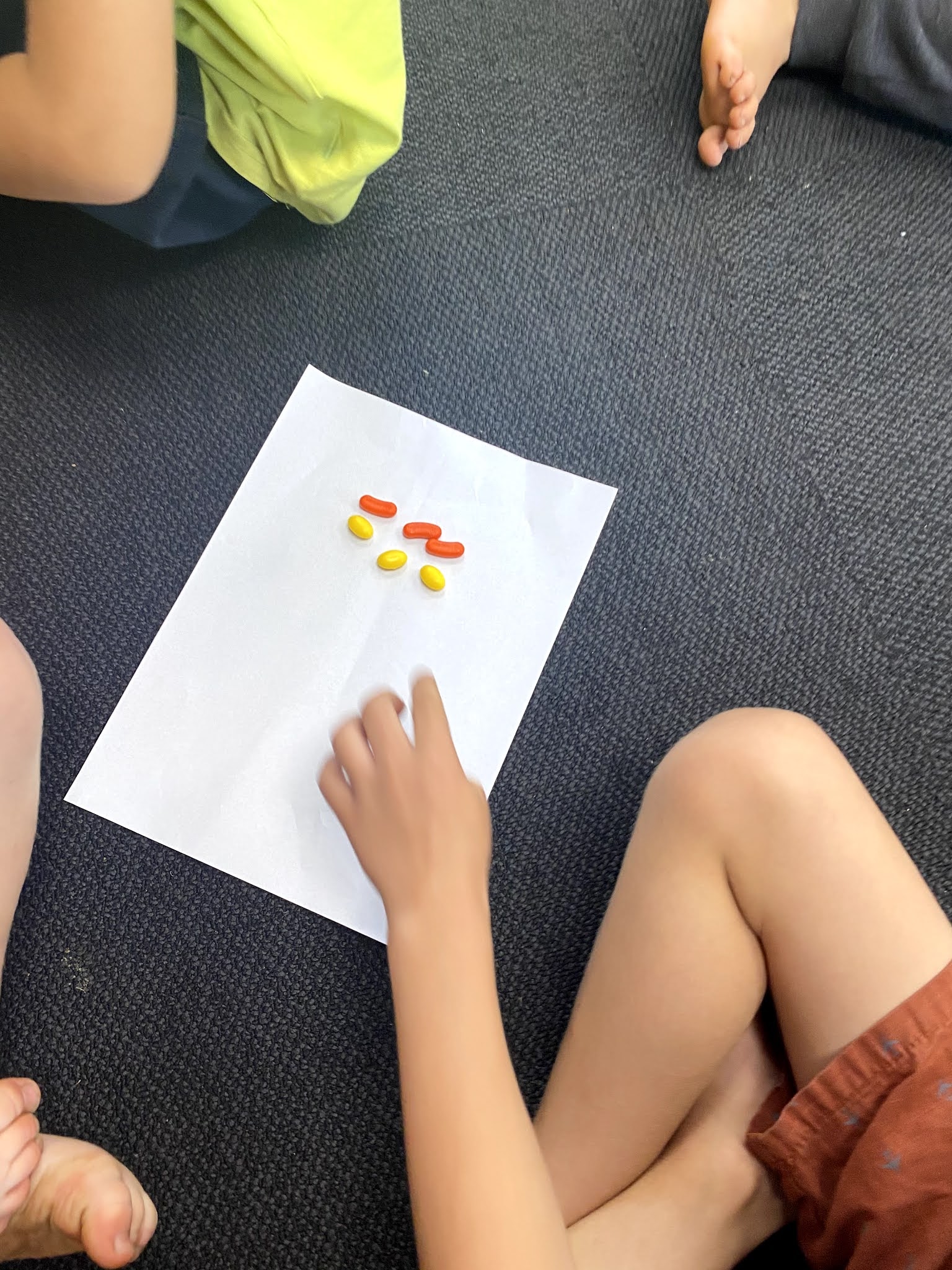
This term I started with purely the deep understandings within the woodin math patterns. Working hard to foster the early big ideas in maths and strengthen understanding of our number system. It has seemed very slow, very explicit and very deliberate, but it is really working! As part of that repeated patterning has been really important, exploring the parts of a whole and developing our ability to notice and discuss. I see patterning to maths, as phonological awareness is to reading and spelling.
Number understanding across the whole class has really progressed, it was just what they needed.
We have slowly worked away, building a deep sense of each numeral with a particular focus on cardinality, counting, comparison and composition, deeply understanding what the numeral means, representing in visual form etc, just like we would explore the alphabetic code in a sequence. As the term has gone on we have started to solve number story narratives, using the woodin patterns to help us. We've also started to look at a group and explore how it can form part of a bigger group, we have then started to explore number talks taking whole to part and exploring how the group can be represented in different ways.
We've got a long way to go and I am excited to learn more about the scope and sequence so that I can come up with something that works for all, no matter what understandings they start school with. A scope and sequence that overcomes the current narrow outcomes and measures we have in place for maths.


So will we start Agency next term? No, we are not quite there yet...but I will be planning a mantle that takes 10-12 weeks over Term 2 and 3 so that we can have the benefit of what we are currently doing, but still the amazing engagement that Number Agency brings.
Comments
Post a Comment